Every evening, thousands of traders do the same ritual: screenshot an options chain from their broker, drop it into ChatGPT, and type a question underneath. One thread on r/options where a trader described exactly this workflow — uploading screenshots of full option chains so the model could read bid/ask spreads and open interest — collected 1,682 upvotes and 379 comments (link). The method genuinely works, right up until it doesn't: the same subreddit is full of screenshots of ChatGPT botching option math (example), and the top reply on the popular thread says it all — "should be used as guidance, not relied on." The model can only read the pixels you fed it, and the pixels were already twenty minutes stale when you took the screenshot.
The prompt-pack culture is the same story one level up: traders share multi-paragraph prompts that begin with "paste today's price, RSI, and moving averages below" (example). The bottleneck was never the model. It's the data feed.
There's a standard fix for this now. MCP — the Model Context Protocol — lets an AI client (Claude Desktop, Cursor, ChatGPT, and others) call a data server directly, so the agent reads structured numbers instead of screenshots. Users on r/mcp have started scoring stock-data MCP servers on exactly the questions that matter (one such scorecard), and that thread exposes a hole we care a lot about: every server they tested covers US markets. Not one answers a question about the TSX.
OptionsJuice is a Canadian options and volatility research platform, and it ships an MCP server with the stuff nobody else carries: Montreal Exchange options chains with per-strike liquidity and IV, plus the full US toolkit (earnings moves, IV rank/percentile, screeners, backtests). This post connects an agent to it and then answers real questions harvested from Reddit, with the actual tool outputs — nothing invented.
Connect in one paste
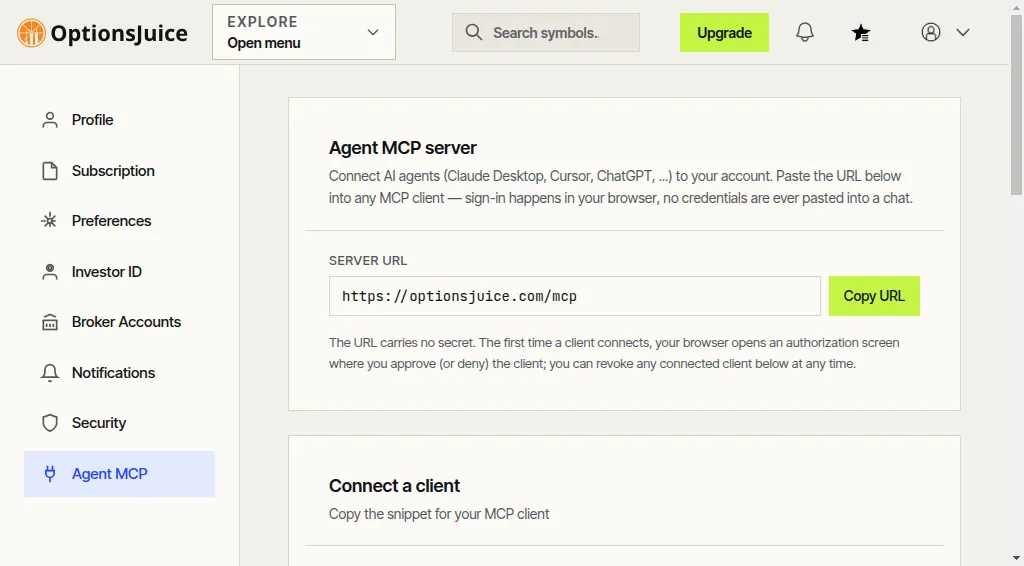
You don't paste API keys into your agent. You paste one URL:
-
Sign in at OptionsJuice.ca and open Settings → Agent MCP. The Agent MCP server card shows your server URL — click Copy URL. It's just
https://optionsjuice.com/mcp, and the URL carries no secret. -
In your client, add a custom connector/server and paste that URL:
- Claude Desktop: Settings → Connectors → Add custom connector
- Cursor: Settings → MCP → Add custom MCP server, or run
claude mcp add --transport http optionsjuice https://optionsjuice.com/mcp - ChatGPT: Settings → Apps & Connectors → Create an app (custom MCP server)
-
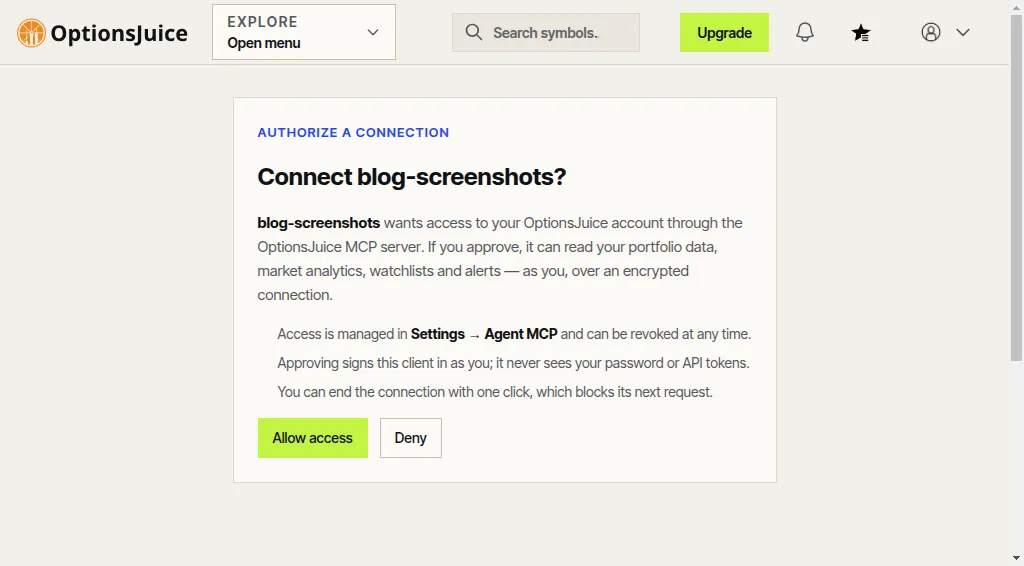
On first connect, your browser opens an OAuth authorization screen — approve it there. That's the whole auth story: OAuth 2.1 with dynamic client registration and PKCE, short-lived access tokens, rotating refresh tokens. No credentials are ever pasted into a chat. If a client can't do OAuth, Settings → Agent MCP also exposes a legacy token under a collapse — treat it like a password.
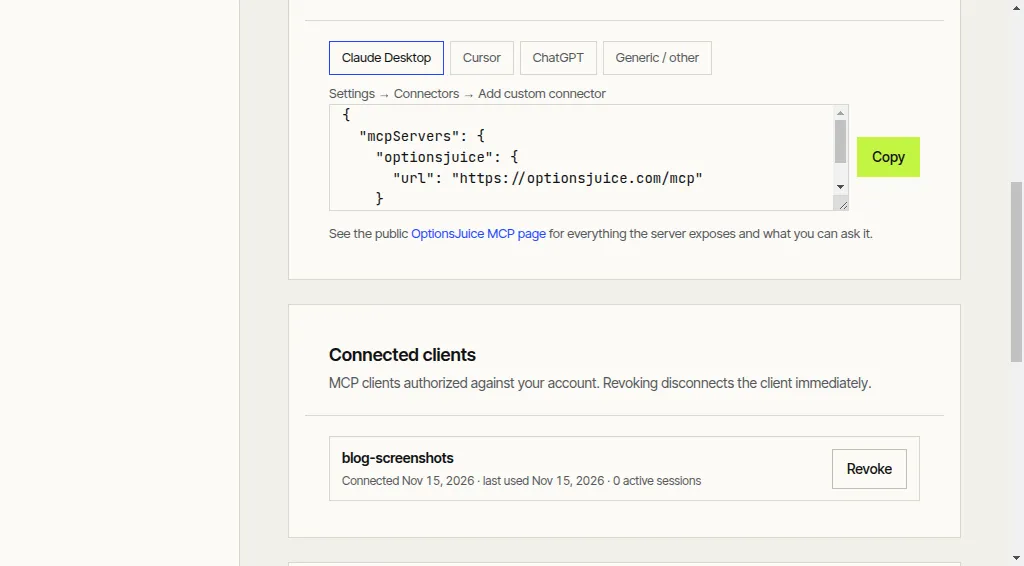
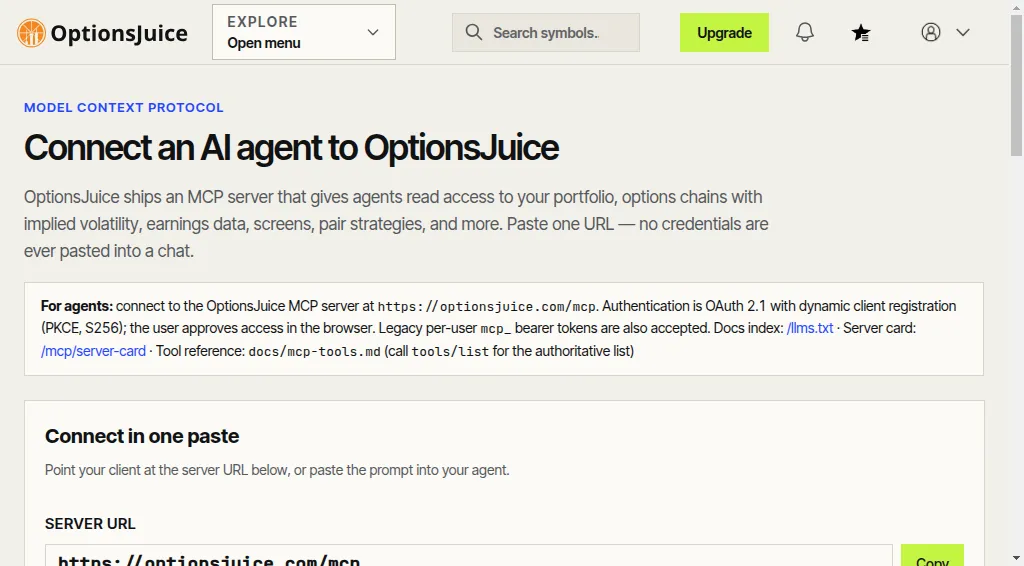
The public /mcp page has the same instructions with copy-paste snippets for each client. That's it — your agent now has structured market data. Here's what it can answer.
"Is the .TO line actually tradeable?"
"the spreads are too wide for me to even consider... Even SHOP.TO isn't liquid, just compare it to the American listed version... the OI on certain contracts is massive, but there's no volume which makes it illiquid for trading." — r/CanadianInvestor, thread
"A lot of Canadian options have spreads that's almost 20-30% of the premium if you manage to sell any." — r/CanadianInvestor, thread
This is the single most common Canadian options complaint on Reddit, and until now there was no tool that could measure it. Ask your agent:
"Show me the XIU.TO option chain for the December 18, 2026 expiry, strikes 50 through 58."
Real output (captured 2026-11-10, iShares S&P/TSX 60 at $54.42 CAD), trimmed to the lines that matter:
| strike | bid | ask | volume | open interest | spread % of mid |
|---|---|---|---|---|---|
| 51 C | 3.52 | 3.69 | 0 | 32,501 | 4.7% |
| 54 C (ATM) | 1.06 | 1.23 | 0 | 14,080 | 14.8% |
| 55 C | 0.54 | 0.68 | 0 | 24,793 | 23.0% |
| 56 C | 0.25 | 0.34 | 0 | 65,002 | 30.5% |
| 54 P (ATM) | 0.81 | 0.94 | 20 | 14,077 | 14.9% |
| 50 P | 0.16 | 0.23 | 0 | 22,915 | 35.9% |
The Reddit folklore, now measured: 65,000 open interest at one strike, zero contracts traded that session, ATM spreads around 15% of mid, wings above 35%. An agent with this data stops guessing whether a Canadian chain is tradeable — it reads the spread, the volume, and the open interest on every strike, and it gets honesty flags too: each contract comes with quote-quality checks, so one-sided books and ~intrinsic quotes can't sneak into an answer.
"Should I trade the US line or the Canadian line of a dual-listed name?"
"For the CAD and the US version (BB.TO and BB for example) premiums are always way better on the US side than Canadian." — r/Questrade, thread
Same company, same day, same expiry — Shopify, Dec 18 2026:
"Pull the December 18, 2026 option chains for both Shopify listings — SHOP in the US and SHOP.TO in Canada."
| Metric | SHOP (USD line) | SHOP.TO (CAD line) |
|---|---|---|
| Spot | $143.89 | C$205.13 (same company, different currency) |
| ATM call bid/ask | 9.60 / 10.15 | 11.40 / 14.85 |
| ATM call spread | 5.6% of mid | 26.3% of mid |
| ATM call session volume | 47 | 0 |
| ATM call open interest | 23,117 | 17 |
| Whole-chain option volume that day | 41,182 | 281 |
Same underlying, roughly 147× the traded volume, and a spread five times tighter on the US line. This is the exact arithmetic Canadians do by hand — journaling shares to NYSE, paying FX conversion, weighing broker fees — and it's now one question to the agent. Follow up with "and how does the volatility compare?" and the agent puts each line's ATM IV, IV percentile and 30-day realized volatility side by side.
"Which earnings straddles should I enter today?"
"What the easiest way to see the expected move from option pricing? ... TSLA's expected move from Wednesday Q3 earnings" — answers recite the 0.8×-ATM-straddle folk formula — r/thetagang, thread
"The biggest challenge I've run into is finding something that can handle the stock selection part (filtering by earnings date)." — r/options, thread
Forget the formula — ask for the data. Two questions. First, the calendar:
"Which large US companies report earnings this week?"
Then, for the names that interest you, the history and the current implied move:
"Show me the earnings history and the implied move for CRWV, ONON, and NVDA."
Real output, 2026-11-10:
- CoreWeave (CRWV) reports today after close. Options currently imply a 22.5% one-sigma move. Its only prior quarter as a public company: implied 18.8%, stock moved +6.6% — the straddle market has already been wrong on this name once.
- On Holding (ONON) reported this morning before open; the market priced 5.7%. Its last six quarters ran implied 13.6–17.6% against realized moves of −8.9% to +18.3% — implied has overshot reality five times out of six.
- NVIDIA (NVDA) reports Nov 17 after close; the chain implies 13.1%. The last six prints: implied 9.4–13.7%, realized −8.5% to +16.4% — roughly fair, occasionally badly wrong in both directions.
Every row also shows the move priced into a ~30-day ATM straddle and what the stock actually did over that same horizon, so "did selling/premium-buying pay last quarter" is a lookup, not a backtest you have to build. Where history doesn't exist — a recently IPO'd name, an ETF — the agent says so instead of inventing a number.
"Which stocks have the highest IVP right now?"
"Is there a screener (preferably free) that shows you which stocks currently have a higher IV than their historical average?" — r/thetagang (thread); "does anybody have recommendations for a website that shows options and their IV rank and/or percentile?" — r/options (thread)
The usual answers are Market Chameleon and Barchart — both paywalled past a handful of rows. It's one question here:
"Which stocks have the highest IV percentile right now? Check both the US and Canadian markets."
US: 5,730 symbols with IV data; the top of the sort on capture day included ASTS (IV 128%, IVP 99.6) and ARKG (IV 69%, IVP 99.6).
Canada: 397 symbols with IV data — a screen that, as far as we can tell, exists nowhere else. Top of the CA sort on capture day:
| Ticker | ATM IV | IV percentile | Market cap |
|---|---|---|---|
| SU.TO | 37.0% | 99 | C$112B |
| CAE.TO | 47.6% | 99 | C$12.1B |
| PXT.TO | 48.2% | 99 | C$1.9B |
| AVGO.TO | 57.0% | 98.8 | C$301B |
| MU.TO | 75.5% | 98.8 | C$201B |
And the sidebar every IV screener owes you: IV rank vs IV percentile. Traders complain constantly that the two disagree — one r/options poster found rank and percentile "25+ points apart on 16 of my top 60 picks" (thread), and thinkorswim famously mislabels one as the other (thread). Every row carries both (over 90/180/365-day windows), plus 30-day realized volatility and detrended IV z-scores — three outlier-resistant ways to answer "is this premium rich?", all computed with one published definition.
"How would the wheel have done on a TSX name?"
"Questrade does not allow cash-secured puts [in a TFSA]... selling deep ITM covered calls is the same thing. What I can't figure out is, how are those people not seeing diminishing returns?" — r/CanadianInvestor, threads here
The wheel is Reddit's favorite strategy and the least-backtestable one for Canadians, because it needs historical option chains for TSX names. Ask:
"Backtest the wheel strategy on Royal Bank of Canada over the last 180 trading days."
Real output, Royal Bank of Canada, Feb 22 – Nov 10 2026, all CAD: return +19.3% vs buy-and-hold +21.4%; premiums collected C$44,841 on a C$23,400 capital base; 80% of closed cycles profitable; max drawdown 6.7%; six put assignments, five call-aways; 63% of days in cash; volatility 25.8% below the stock. The reply includes the full trade ledger — every put and call sold, with its outcome and P&L — and you can tell it your broker's commission, so the "premiums must beat my $0.35/contract broker fee" question is a re-run with one number changed.
Note what the SPY version of the same backtest said this year: +5.9% for the wheel vs +7.9% for just holding SPY. The tool answers the question honestly even when the answer is "the wheel lost to buy-and-hold" — which is precisely the diminishing-returns answer that thread was looking for.
What your agent does NOT get
The r/mcp crowd has settled this question already: agents should do the research, and a deterministic process should do the trading (thread). OptionsJuice's MCP is built to that division of labor:
- Read-only market data and analytics. Nothing here places, routes, or suggests order flow. There is no trade execution — connect a brokerage account and the agent can read holdings and positions, that's all.
- Numbers, not guesses. Tools return structured data — chains with per-contract quote-quality flags, IV histories, earnings moves with their quote bases. Where data doesn't exist, the tool says so. Missing is never silently rewritten to zero.
- Not official data. Everything the agent reads here comes from OptionsJuice's own pipeline. It is not official exchange data, and it should not be construed as such: before you make a financial decision based on anything in this post, check the numbers against a licensed data provider or your broker.
- Credentials stay out of the conversation. The only credential-shaped input (a brokerage refresh token) belongs in the OptionsJuice app itself, never in a chat. Auth to the MCP server is a browser OAuth screen; the URL you paste carries no secret.
- Analytics, not advice. Screens, pair candidates, and backtests are computed views of stored data — research input, not recommendations.
- Revocable. Every client you've connected is listed in Settings → Agent MCP; revoke one and its next call fails.
Try it
The five questions above are the tip of the tool list — there are 30+ of them, covering watchlists, alerts, term structure, chain history exports, pair screening, and more. The full question→tool table is on /mcp.
If you trade options on TSX names, or you want your agent working from chains and IV history instead of screenshots: connect your agent at OptionsJuice.ca/mcp — it's one URL paste and a browser approval. The OptionsJuice landing page has the rest of the picture: screeners, wheel backtests, and portfolio analytics with your own accounts.
Comments are disabled.